






How Are Ethiopia’s FOB Prices Determined? — Understanding Price Formation Through Industry Structure

Ethiopia is the birthplace of coffee and remains one of the most sought-after producing countries in the world today. At the same time, its pricing structure is quite distinctive compared to other origins, and how FOB prices are actually determined is not widely understood. They are often assumed to move in line with the international market, but in reality, Ethiopia’s FOB prices do not follow global prices in a simple or direct way. The international market serves only as a reference point; the actual prices are formed based on institutional frameworks and the structure of domestic transactions.
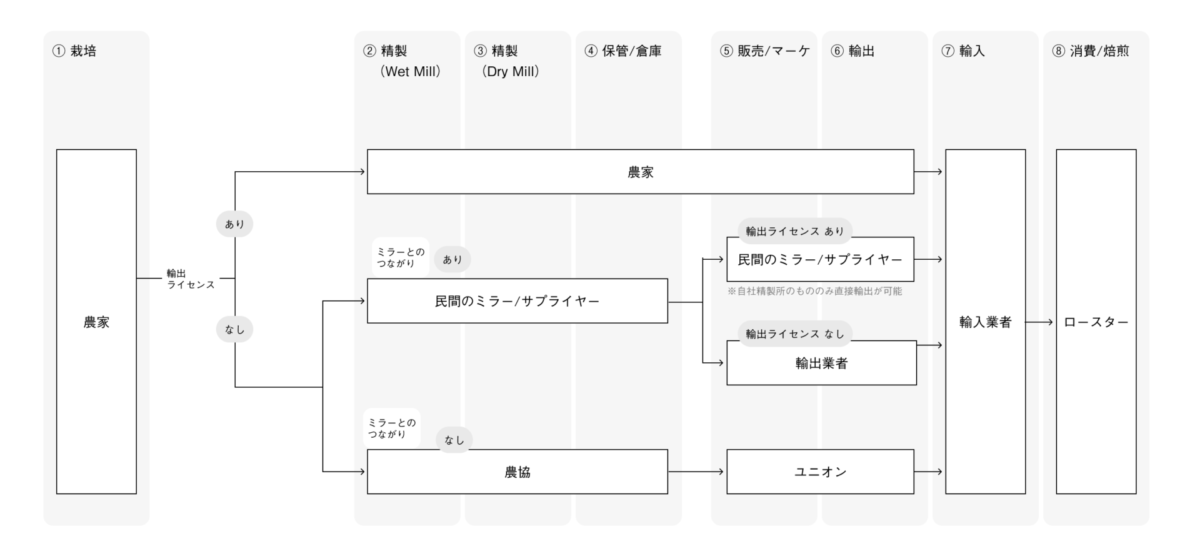
Ethiopia’s coffee industry is fundamentally built on smallholder farmers. Most farmers focus on cultivation and cherry harvesting, while post-harvest processes such as processing, drying, and sorting are handled by nearby washing stations. Only a limited number of farmers export coffee themselves; in most cases, exports are carried out through private mills and suppliers, or through cooperative unions. This clear separation of roles—production, processing, and exporting—is a defining characteristic of the coffee industries in Ethiopia and, more broadly, East Africa.

Heleanna Georgalis, CEO of Moplaco
A key element in understanding Ethiopia’s FOB pricing is the existence of a government-involved minimum export price. In Ethiopia, export contracts cannot be registered if they fall below a certain minimum price. This minimum export price is not fixed; it is updated weekly based on market conditions such as international prices and exchange rates. However, the range of fluctuation is quite limited—typically only a few cents, and at most several tens of cents.
The purpose of this minimum export price, set by the Ethiopian Coffee and Tea Authority, is to protect the sustainability of Ethiopia’s coffee industry and to preserve the international value of Ethiopian coffee. By establishing a price floor, the system prevents sudden drops in global prices from directly cascading into domestic transactions and cherry prices, which could rapidly destabilize farmers’ incomes. Since smallholder farmers account for the majority of production in Ethiopia, sharp price declines can have a direct impact on their ability to continue producing in subsequent years. The minimum export price functions as a safeguard against these risks.
This system also helps prevent excessive price competition among exporters. Coffee is one of Ethiopia’s key sources of foreign currency, and aggressive underpricing driven by short-term market fluctuations could undermine the value of the entire origin. For this reason, the minimum export price system is not designed to push prices up or down, but rather to limit volatility and maintain overall stability within the producing country.
On the other hand, when it comes to cherry purchase prices paid to farmers—an earlier stage than FOB pricing—there is no nationally fixed minimum price set by the government, as there is at the export level. Cherry prices are formed based on local supply and demand, expected yields, and quality potential. Prices offered by cooperative unions are often used as reference points, resulting in a certain level of price consistency. In practice, cherry pricing is neither a completely free market nor entirely regulated; it is shaped by a combination of institutional rules and long-established trading practices.
Ethiopia’s FOB prices do not fluctuate sharply in the short term like differential prices in some other origins. Over the course of a harvest year, price levels tend to remain relatively stable and do not change dramatically. As a result, unlike in countries such as Brazil or Colombia, there is generally less need to closely time purchases in response to daily movements in the international market.

Because minimum export prices are institutionally defined, significant differences in FOB prices between exporters are uncommon for coffees of the same specifications, except in the case of high value–added lots. Rather than comparing FOB prices from different exporters in excessive detail, we believe it is more important to build long-term relationships with reliable exporters who consistently provide stable quality and transparent information year after year.
Understanding Ethiopia’s FOB prices also means understanding the systems and industry structure behind them. At TYPICA, we aim to support both producers and roasters in achieving transparent direct trade, grounded in a clear understanding of these underlying dynamics.